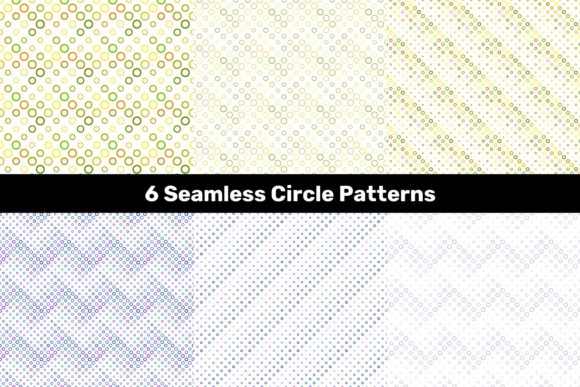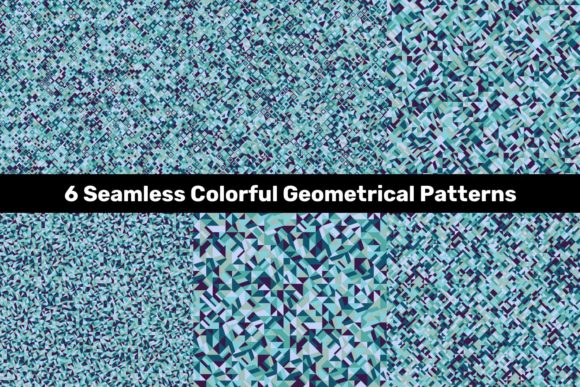
6 Seamless Geometrical Patterns That Transform Ordinary Projects into Cohesive Visual Experiences
You have probably landed here because you typed something like "modern background design" into a search engine, or maybe you are staring at a blank canvas in Illustrator wondering why your tiling looks off. This is not a theoretical breakdown of geometry. This is a practical look at a specific set of 6 seamless geometrical patterns and why the difference between a messy repeat and a flawless application often comes down to a few overlooked details.
What You Are Actually Looking At
When we talk about 6 seamless geometrical patterns, we are not talking about six random shapes thrown onto a grid. We are referring to a curated collection of repeating vector tiles—often including interlocking hexagons, nested chevrons, isometric cubes, concentric diamonds, woven lines, and radial mandalas. These are built mathematically so that the left edge marries perfectly with the right edge, and the top aligns with the bottom without a visible seam.
People are interested in this specific bundle because it bridges the gap between cold mathematical precision and warm, approachable design. A marketer might use them for social media templates where a gritty, organic texture feels out of place. A small business owner might print them on packaging where a broken repeat would look cheap. The appeal is reliability. But that reliability only holds if you treat the file correctly from the start.
Why Most People Struggle with "Seamless" Files
The word seamless is thrown around carelessly in the design world. I have watched talented creators download a "seamless" pattern, apply it as a background, and immediately see a harsh vertical line slicing through their layout. They blame the file. Nine times out of ten, the file is fine. The mistake is in the scaling method or the export settings.
A true seamless pattern tile is usually built on a perfect square artboard—say 1000 by 1000 pixels. If you accidentally resize that square to 1002 pixels wide during export, you have introduced a sub-pixel offset. The math breaks. The seam appears. The pattern looks amateurish. This is not a flaw in the 6 seamless geometrical patterns you just purchased; it is a workflow error that mimics a product defect.
Common Missteps When Applying Geometrical Repeats
Let us walk through the friction points I see repeatedly. These are not character flaws. They are just gaps in a typical tutorial process. Most courses teach you how to drag a pattern onto a canvas but never explain what happens when that canvas needs to become a printed flyer or a responsive website header.
Mistake 1: Treating size as an afterthought. You find a gorgeous hexagonal mesh in the 6 seamless geometrical patterns set. You scale it down to 30% to fit your business card, and suddenly the clean lines turn into a muddy blur. Vector patterns can handle scaling, but your stroke weights do not automatically adjust unless you check the "Scale Strokes & Effects" box in Adobe Illustrator. Overlooking this creates inconsistent line weight across your branding, making a premium geometric design look clumsy.
Mistake 2: Color replacement without understanding the structure. Geometrical patterns often rely on contrast to create depth. A popular one in these bundles uses alternating light and dark triangles to simulate a folded ribbon effect. I watched a freelancer globally recolor the pattern with a monochromatic palette, and the dimensional illusion collapsed instantly. The folds became flat shapes. The pattern lost its purpose. If you need to shift hues, isolate the highlight and shadow elements separately rather than pouring a single color over the entire group.
Mistake 3: Assuming "seamless" means "any format." This is the silent killer of projects. A pattern tile might work beautifully in a vector software's pattern swatch, but when you export it as a repeating CSS background for a website, the alignment rules change. The 6 seamless geometrical patterns you downloaded as an .EPS or .AI file need to be exported to a flat raster tile—PNG or SVG—with exact pixel dimensions. If the original tile is 500 by 500 pixels, your CSS must define background-size: 500px 500px; precisely. Guessing the size leads to sub-pixel drifting and visible seams on scroll.
Hidden Costs of Cutting Corners on Pattern Preparation
When a pattern fails, the cost is rarely just the five dollars you spent on the asset. The real expense is the credibility leakage. If you are a blogger using a distorted chevron pattern behind your headline text, readers may not know why the page feels off, but they will sense a lack of polish. That split-second judgment affects how they perceive your advice.
For entrepreneurs selling physical products, the consequences are concrete. Imagine printing a run of 500 journals with a cover featuring an isometric cube pattern from your 6 seamless geometrical patterns set. If you scaled the pattern non-proportionally to fit the cover dimensions, the cubes become rectangular blocks. The geometry distorts. The product looks misprinted, even though the printer technically reproduced your file perfectly. Returns happen. Trust erodes. This is avoidable with one extra check before sending files to production.
How to Adjust Patterns Without Breaking the Repeat
The safest route is to work inside the pattern editing mode of your design tool. If you received the 6 seamless geometrical patterns as a grouped set of individual elements, resist the urge to drag and resize each shape manually. Instead, duplicate the tile, align it to the original's edges, and only then start shifting internal elements. This way, whatever leaves the right edge appears on the left edge simultaneously. You maintain the mathematical loop.
A practical example: suppose you want to increase the spacing between elements in a concentric diamond pattern to make it feel airier. Do not just select all and scale down from the center. That shifts the boundary alignment. Instead, select all interior elements while leaving the invisible bounding box intact, then scale down or adjust distribution. The tile boundary remains absolute at 1000 pixels, but the density inside changes safely. Test the repeat on a 2x2 grid immediately. Do not wait until you have applied it to a full poster.
File Types and When Each One Betrays You
The 6 seamless geometrical patterns might arrive as a ZIP containing AI, EPS, PNG, and perhaps SVG formats. Each serves a different master. The vector originals are your source of truth—editable, infinitely scalable, perfect for print. The PNGs are rasterized exports, likely at 300 DPI, great for quick digital mockups but dangerous to enlarge. The SVG option is underrated and often mishandled.
SVGs containing complex geometrical repeats can balloon in code size if the designer left unnecessary anchor points. I have seen a single seamless tile generate 40,000 lines of path data because it was auto-traced rather than built with clean primitives, even though the pattern itself is one of the 6 seamless geometrical patterns that look elegantly simple. Before embedding an SVG in a website, run it through an optimizer. Remove redundant nodes. Simplify decimal precision. A 2MB pattern tile crushes page speed, and slow-loading backgrounds cause layout shifts that Google penalizes heavily.
For print projects, always confirm whether your printer accepts native vector files or requires flattened PDFs. If you send an AI file with linked pattern swatches that are not embedded, the printer's system will throw a missing asset error. Your gorgeous geometrical cover prints as a blank gray box. Embarassing, expensive, and entirely preventable. Package the file. Embed everything. Then send.
Choosing Variations That Align with Your Medium
Not all six variations in a bundle are equally suited to every task. The woven line pattern might look stunning on a desktop monitor but turn into a vibrating optical illusion on a mobile screen due to aliasing. The radial mandala might print gorgeously at poster size but lose all detail in a website footer thumbnail.
A creative entrepreneur making digital wallpapers would do well to select the isometric cube or concentric diamond variants, as these hold up to extreme cropping on different device aspect ratios without appearing unbalanced. A course creator designing slide decks might lean toward nested chevrons, which naturally guide the eye toward central content areas without competing with that content.
Be deliberate about contrast ratios as well. An interlocking hexagon pattern with subtle tonal shifts may feel sophisticated on a large textile print but wash out completely on a matte paper stock that absorbs ink. Test a small swatch under the final production conditions. Test on the actual substrate. Test under the lighting environment where the pattern will be viewed. The 6 seamless geometrical patterns are conceptually perfect, but physical reality has a say in the outcome.
Pre-Purchase and Pre-Use Checklist
Before you commit to using any asset, especially if you are buying rather than creating, verify a few quiet details. Check the license type. Some bundles restrict use on print-on-demand platforms, which directly affects small business owners selling mugs and t-shirts. That restriction can turn a great pattern into a useless file for your specific revenue model.
Open the vector file and examine whether the pattern is built as a clipping mask over a repeating tile or as a true swatch. Masked patterns are harder to edit globally. If you need to change a repeating color across all instances in a document, a true swatch change propagates instantly. Chasing down linked instances wastes hours that a freelancer cannot afford to lose.
Also, sample the colors in LAB or HSL values rather than trusting the screen display. Some geometrical patterns rely on complementary hues that shift dramatically when converted from sRGB to CMYK. A vibrant teal and coral combination can turn muddy and dissonant in print. The pattern's geometry remains flawless, but the emotional response it evokes degrades. Adjust the palette in CMYK preview mode before finalizing anything bound for ink.
Finally, consider how the pattern scales across your brand's entire ecosystem. Will this specific woven line design work from a business card up to a trade show banner without requiring different versions? If the answer is yes, you have found a versatile asset. If the answer is no, plan for adaptation. Create a collection of scaled variants derived from the same original 6 seamless geometrical patterns so your visual identity stays cohesive regardless of output size.
Working with geometrical repeats rewards patience and punishes haste. The difference between a design that feels unintentionally dated and one that feels timelessly structured often comes down to those quiet checks made before clicking export. Treat the pattern tile boundaries like sacred geometry—because they literally are.