Mastering the Art of Leaf Seamless Patterns Graphic for Modern Visual Design
The natural world has always been an inexhaustible source of inspiration for artists and designers, but few motifs carry the universal appeal of botanical elements. Among these, the leaf seamless patterns graphic stands out as a versatile tool that bridges organic aesthetics with digital precision. Whether you are designing fabric for a fashion line, creating a website background, or developing packaging for an eco-conscious brand, understanding how these patterns function can dramatically elevate your visual output.
At its core, a seamless pattern is a repeatable tile that, when duplicated horizontally and vertically, creates an uninterrupted surface without visible borders or breaks. When leaves become the central motif of such a pattern, the designer faces a unique challenge: preserving the delicate, irregular shapes of foliage while ensuring the mathematical continuity required for seamless repetition. This tension between organic form and geometric precision is precisely what makes a well-executed leaf seamless patterns graphic so visually compelling.
The Structural Anatomy of a Repeating Leaf Motif
To appreciate what goes into a quality botanical repeat, it helps to examine the invisible architecture that supports the visible design. Every seamless pattern relies on a tile boundary—a defined rectangle or square that repeats infinitely. The edges of this tile must align perfectly so that a leaf tip extending beyond the right edge reappears seamlessly on the left edge of the adjacent tile.
Designers working on a leaf seamless patterns graphic typically employ one of several repeat methods. The most straightforward is the basic grid repeat, where a single tile is duplicated side by side. This works well for densely packed foliage patterns where individual leaves overlap and interlock in ways that mask the repetition. More sophisticated is the half-drop repeat, where every other row shifts horizontally by half the tile width. This staggered arrangement mimics the irregular clustering of leaves in nature and significantly reduces the perception of mechanical repetition.
Another technique involves creating mirror repeats, where tiles are flipped horizontally or vertically. While this can produce interesting symmetrical effects, it demands careful handling of lighting and shadow directions to avoid an unnatural appearance. The most skilled pattern designers understand that the goal is not to eliminate repetition entirely—some repetition is inherent and even aesthetically pleasing—but to make the transition between tiles invisible to the casual observer.
Why Designers and Brands Gravitate Toward Leaf Repeats
The enduring popularity of botanical patterns is not accidental. A leaf seamless patterns graphic carries multiple layers of psychological and practical appeal that make it suitable across diverse industries and applications.
From a psychological perspective, leaves evoke associations with growth, renewal, and vitality. Humans have an innate affinity for natural forms, a phenomenon known as biophilia. When a consumer encounters a product featuring leaf patterns, even subtly, the brain registers a connection to the living world. This can translate into perceptions of freshness for food packaging, wellness for personal care products, or sustainability for eco-friendly brands.
On a practical level, leaf motifs offer remarkable flexibility in tonal range. A dense tropical leaf repeat in deep greens and teals can convey lush abundance for a resort brand, while a sparse scattering of delicate, line-drawn leaves in muted earth tones can serve a minimalist stationery line. The same leaf seamless patterns graphic framework can be adapted through color, scale, density, and rendering style to serve vastly different brand personalities.
Digital product designers also value these patterns for their ability to add visual interest without overwhelming content. A subtle leaf repeat at low opacity behind text can soften an interface and introduce warmth without compromising readability. This makes botanical repeats particularly popular for wellness apps, nature-focused blogs, and sustainable lifestyle platforms.
Scale and Density Considerations for Different Applications
One variable that dramatically changes the impact of a leaf seamless patterns graphic is scale. A pattern designed for use on a smartphone case requires completely different proportional thinking than one intended for wallpaper or upholstery. Small-scale patterns, where individual leaves measure only a few millimeters, tend to read as texture at typical viewing distances. They can add depth and richness to a surface without demanding focused attention.
Large-scale leaf repeats, by contrast, function almost as murals. A single repeat tile might feature oversized monstera leaves stretching across thirty centimeters or more. These patterns command attention and work best on surfaces where the full repeat can be appreciated, such as accent walls, large-format textiles, or statement apparel pieces.
Density functions as the other critical variable. A high-density leaf seamless patterns graphic packs many elements into the tile, creating a lush, immersive feel. This approach works beautifully for maximalist interior design, bold fashion statements, and packaging that aims to convey abundance. Low-density patterns, with generous negative space between leaf elements, read as more sophisticated and restrained. They suit contemporary branding, elegant stationery, and applications where the underlying surface color needs to play a meaningful role in the overall composition.
Color Palettes and Their Strategic Implications
Color selection transforms the character of a leaf pattern entirely. Naturalistic palettes—those drawing directly from observable foliage—create patterns that feel grounded and authentic. A pattern featuring olive greens, sage, and muted yellows evokes Mediterranean landscapes, while deep forest greens with touches of burgundy suggest temperate woodlands.
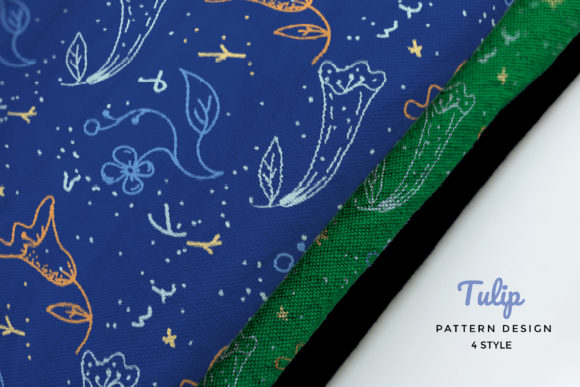
Designers increasingly experiment with non-naturalistic color treatments in their leaf repeats. Monochromatic schemes reduce the pattern to tonal variations of a single hue, which can create striking, contemporary effects. A leaf pattern rendered entirely in shades of navy blue feels sophisticated and unexpected. Metallics—gold, copper, or silver leaf elements against dark backgrounds—introduce luxury connotations suitable for premium packaging and high-end interior products.
The color framework chosen for a leaf seamless patterns graphic also affects its versatility. Patterns designed in neutral, restrained palettes integrate more easily into existing design systems, while bold, distinctive color choices make patterns memorable but potentially harder to pair with other design elements. Commercial pattern collections often include multiple colorways of the same tile design to serve different market segments and seasonal needs.
Digital Creation Workflows and Tooling
Creating a seamless leaf pattern from scratch involves a workflow that blends artistic sensibility with technical precision. Most contemporary designers work within vector illustration software such as Adobe Illustrator or Affinity Designer, though raster approaches using Procreate or Photoshop remain popular for hand-drawn, textured styles.
The process often begins with individual leaf illustrations, whether hand-drawn and scanned, created digitally with a tablet, or sourced from public domain botanical illustrations. These base elements are then arranged within the tile boundaries. The designer must carefully position elements so that anything overlapping the top edge has a corresponding element overlapping the bottom edge at the same horizontal position, and similarly for left and right edges.
Modern tools simplify this process considerably. Illustrator's Pattern Mode, introduced in recent versions, allows designers to visualize repeats in real time and make adjustments with the full context visible. As the designer moves a leaf element, they see it update across multiple tiles simultaneously. This immediate feedback loop accelerates the creative process and reduces the trial-and-error that historically characterized pattern design.
For those working on a leaf seamless patterns graphic intended for fabric printing, additional considerations come into play. Screen printing imposes color separation requirements and limitations on the number of colors that can be economically printed. Digital fabric printing offers greater freedom but still demands attention to color profiles and how pigments interact with specific fabric substrates.
Integration Across Industries and Media
The application domains for botanical repeats extend far beyond what many casual observers might expect, and understanding this breadth reveals why skill with leaf patterns remains a valuable design competency.
Textile and Surface Design
This represents the most traditional home for pattern work. A leaf seamless patterns graphic can appear on apparel fabrics ranging from flowing rayon dresses to structured cotton shirting. Home textiles present another major category, with leaf repeats adorning duvet covers, curtain panels, upholstery fabrics, and decorative pillows. The hospitality industry consumes vast quantities of these patterns for hotel furnishings, where botanical themes contribute to a sense of retreat and comfort.
Digital Product Interfaces
Web and app designers have increasingly embraced subtle pattern backgrounds as alternatives to flat color or gradient backgrounds. A delicate leaf repeat at low opacity can differentiate a brand's digital presence without the load times associated with photographic backgrounds. This application demands particular attention to contrast ratios and accessibility standards, ensuring that text overlaid on the pattern remains legible for all users.
Print and Branding Collateral
From business cards with a subtle debossed leaf pattern to full-scale trade show booth graphics featuring oversized botanical motifs, print applications test a pattern's versatility across dramatically different sizes and substrates. A leaf seamless patterns graphic designed for letterpress stationery at a small scale might reveal entirely different qualities when blown up for a retail window display. Forward-thinking designers test their patterns at multiple scales before finalizing to ensure the design holds up across the full range of potential uses.
Product and Packaging Design
Consumer packaged goods frequently employ leaf patterns to communicate natural ingredients, environmental responsibility, or product freshness. Tea packaging, organic food labels, cosmetic boxes, and candle vessels all benefit from botanical repeats. The challenge here is that the pattern must read clearly even on curved surfaces and small formats. Designers often simplify their leaf motifs for packaging applications, ensuring that the essential character survives even when only a fragment of the repeat is visible.
Distinguishing Quality in Botanical Pattern Work
Not all leaf patterns achieve equal results, and learning to evaluate quality benefits both creators and consumers of pattern assets. A superior leaf seamless patterns graphic exhibits several hallmarks worth understanding.
Seam invisibility is the most fundamental quality indicator. When repeated, the tile boundaries should disappear entirely. Any visible line, jump, or glitch where tiles meet indicates incomplete edge matching. Testing for this involves tiling the pattern at a large size and scanning methodically across the surface to identify breaks in continuity.
Rhythmic variety separates competent patterns from exceptional ones. Nature does not distribute leaves at perfectly regular intervals, and a pattern that mimics this organic irregularity feels more alive. The best patterns establish a rhythm—a sense of organized movement across the surface—without lapsing into mechanical spacing. This involves varying the size, rotation, and placement of leaf elements within the tile.
Depth and layering add dimensionality to what is fundamentally a flat repeating graphic. By including background, midground, and foreground leaf elements that overlap each other, designers create patterns that feel spatially rich rather than graphically flat. Shadow and highlight treatments reinforce this depth, though they must be applied consistently across all tiles to maintain seamlessness.
Edge treatment and rendering consistency are subtle but significant. A pattern that mixes photorealistic leaves with flat vector leaves creates cognitive dissonance. Maintaining a consistent level of detail, similar line weights, and coherent rendering approaches across all elements within the leaf seamless patterns graphic produces a unified, professional result.
Licensing, Sourcing, and Ethical Considerations
For business owners and designers who need leaf patterns but lack the time or expertise to create them from scratch, the market offers numerous sourcing options. Stock platforms host thousands of botanical pattern assets, ranging from individual tiles to full collections with coordinated colorways. However, licensing terms vary enormously, and understanding what usage rights accompany a pattern purchase prevents legal complications down the line.
Some patterns are sold with standard licenses that permit use in personal and limited commercial projects but restrict resale or use in products where the pattern constitutes the primary value. Extended licenses typically allow broader commercial application, including on merchandise for sale. Designers creating patterns for clients should document usage rights carefully and ensure the client understands any limitations.
An emerging consideration involves the provenance of botanical imagery used as reference or base material. As awareness grows around intellectual property rights in the digital design space, some designers explicitly document whether their leaf illustrations are drawn from direct observation, photographic reference they captured themselves, or public domain scientific illustrations. This transparency supports ethical design practice and helps end users make informed sourcing decisions.
The Enduring Role of Botanical Repeats in Visual Culture
Looking across design history, leaf and foliage patterns have appeared in virtually every decorative tradition, from ancient Egyptian wall paintings to William Morris's Arts and Crafts textiles to mid-century modern wallpapers. The leaf seamless patterns graphic of today represents a continuation of this deep human impulse to bring nature's forms into our built environments and daily objects.
What has changed is accessibility. Digital tools have democratized pattern creation, enabling independent designers, small business owners, and hobbyists to produce professional-quality repeats that once required specialized training and expensive equipment. Simultaneously, digital distribution platforms mean that a designer in one country can create a leaf pattern that becomes the signature fabric for a fashion collection in another, collapsing geographical barriers that previously segmented design markets.
For practitioners at any level, the fundamental advice remains consistent: study real leaves closely, understand how they connect to stems, how they overlap, how light plays across their surfaces. The most technically seamless pattern will fall flat if the underlying botanical forms lack authenticity. Combine that observational foundation with solid technical pattern-building skills, and the resulting leaf seamless patterns graphic will serve effectively across whatever applications its users envision.