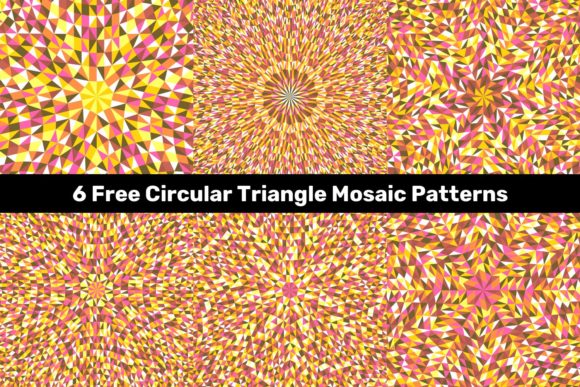
Unlocking Creativity with Free Circular Triangle Mosaic Patterns: A Designer's Guide
Have you ever stumbled upon a geometric design so mesmerizing that it stopped you mid-scroll? Chances are, you were looking at a circular triangle mosaic pattern. These intricate, repeating designs have quietly shaped everything from ancient architecture to modern smartphone wallpapers. They blend mathematical precision with artistic flair, and the best part? You don't need a degree in advanced geometry or an expensive software suite to start using them. In this article, we'll explore the world of free circular triangle mosaic patterns, unpacking six distinct styles, their origins, practical applications, and how you can integrate them into your projects today.
What Exactly Is a Circular Triangle Mosaic Pattern?
At its core, a circular triangle mosaic pattern is a tessellating design where triangular shapes radiate from or converge toward a central point, forming a circular or rotational symmetry. Think of a kaleidoscope: each twist reorganizes colored fragments into a new, perfectly balanced circular image. That's the essence of these patterns—individual triangles working together to build a harmonious whole.
The triangle is the simplest polygon in Euclidean geometry. When you rotate, reflect, or scale it around a fixed axis, you create radial symmetry. Repeat that process multiple times, and suddenly you have a circular mosaic that feels both structured and organic. Unlike square or hexagonal grids, triangular mosaics introduce dynamic angles—60°, 90°, 120°—that generate visual tension and energy. This makes them ideal for everything from mandala-inspired coloring books to parametric architectural facades.
One common misconception is that mosaic patterns are always static or rigid. In reality, circular triangle mosaics can feel fluid and almost organic when the triangles vary slightly in size, color, or orientation. The interplay between repetition and variation is what gives these patterns their enduring appeal.
Why Circular Triangle Mosaics Matter in Modern Design
Geometry isn't just a dusty classroom subject. It's a visual language that communicates order, balance, and creativity. In a world saturated with information, geometric patterns offer a sense of calm and predictability. Our brains are wired to recognize symmetry, and circular patterns specifically tap into a deep psychological comfort—just look at the enduring popularity of mandalas, rose windows, and sacred geometry across cultures.
From a practical standpoint, circular triangle mosaic patterns serve multiple purposes:
- Visual hierarchy: The central focal point naturally draws the eye, making these patterns excellent for logos, icons, and brand marks.
- Scalability: Because they're based on mathematical ratios, triangular mosaics can scale infinitely without losing integrity—perfect for responsive web design and large-format printing.
- Versatility: A single pattern can be recolored, cropped, or layered to fit vastly different aesthetics, from corporate minimalism to bohemian maximalism.
- Cultural resonance: Triangular and circular motifs appear in Islamic geometric art, Celtic knotwork, African textiles, and Indigenous American pottery. Using them thoughtfully connects contemporary work to rich historical traditions.
6 Free Circular Triangle Mosaic Patterns You Can Download and Use Today
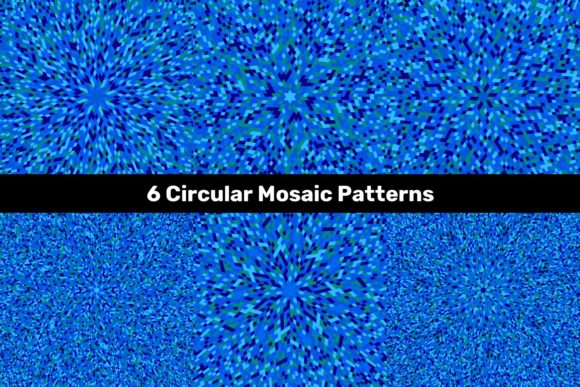
Below, we've curated six distinct circular triangle mosaic patterns that are available for free through various design communities, open-source platforms, and creative commons libraries. Each pattern offers something unique, whether you're a graphic designer, a DIY crafter, an educator, or simply someone who appreciates beautiful geometry.
1. The Classic Equilateral Radial
This pattern uses equilateral triangles arranged around a central point in concentric rings. Each ring adds more triangles, creating a stepped, almost flower-like silhouette. The mathematics is straightforward: 60° angles mean six triangles fit perfectly around a point, then twelve, then eighteen, and so on. The result is clean, balanced, and incredibly satisfying to look at.
Best for: Laser-cut coasters, stickers, app icons, and minimalist branding. Because the triangles are uniform, this pattern also works beautifully as a quilting template or a stained glass design.
2. The Spiral Triangular Pinwheel
Imagine taking a classic pinwheel and constructing it entirely from triangles that grow or shrink as they spiral outward. This pattern introduces a Fibonacci-like progression, where each successive triangle is slightly larger than the last, creating a sense of motion and expansion. It's less rigid than the equilateral radial and feels more dynamic.
Best for: Album covers, event posters, website hero backgrounds, and anything that needs to convey energy and forward momentum. The spiral also makes this pattern popular in kinetic art and animation loops.
3. The Interlocking Triangular Knot
Inspired by Celtic knotwork and Islamic girih tiles, this pattern uses overlapping triangles to create the illusion of woven ribbons. The triangles aren't just adjacent—they appear to pass over and under one another, adding depth and complexity. When viewed from a distance, the overall shape remains circular, but up close, the interlocking details reward close inspection.
Best for: Tattoo flashes, book covers, tapestry designs, and intricate coloring pages. This pattern also lends itself well to embroidery and pyrography (wood burning).
4. The Stained Glass Mandala
This pattern mimics the look of a rose window found in Gothic cathedrals. Triangles of varying sizes are arranged into petal-like clusters, separated by thicker "leading" lines. The interplay between solid shapes and negative space gives it a luminous, translucent quality—even when rendered in flat vector form.
Best for: T-shirt graphics, tote bag prints, sun-catcher templates, and digital art assets. With the right color palette, this pattern can evoke everything from medieval grandeur to psychedelic 1960s posters.
5. The Isometric Triangular Field
While not strictly circular at first glance, this pattern uses isometric triangles arranged across a spherical projection, creating a 3D optical illusion. The triangles appear to form a domed surface, like a geodesic dome flattened into 2D. It's a favorite among game designers and UI artists for its futuristic, tech-forward aesthetic.
Best for: Video game textures, sci-fi interface elements, retro-futuristic posters, and dashboard designs. The isometric perspective also makes this pattern useful for data visualization backgrounds and infographic accents.
6. The Fractal Tri-Spiral
The most complex pattern in this collection, the fractal tri-spiral uses self-similar triangles that branch into smaller versions of themselves at each radial iteration. Zoom in, and you'll find the same pattern repeating at increasingly tiny scales. This recursive quality makes it hypnotic and mathematically profound.
Best for: Album artwork for electronic or ambient music, meditation aids, high-end packaging, and generative art projects. The fractal nature also appeals to math educators looking to visually demonstrate recursion and scaling.
Where to Find High-Quality Free Circular Triangle Mosaic Patterns
The internet is rich with resources, but not all free patterns are created equal. Some come with restrictive licenses, while others are low-resolution or poorly constructed. Here are trusted sources to explore:
- Freepik and Vecteezy: Both platforms offer thousands of free vector patterns with clear licensing terms. Search for "circular triangle mosaic" or "geometric mandala" and filter by free downloads. Always check the attribution requirements.
- Openclipart: A public-domain library where contributors share SVG files freely. The quality varies, but the licensing is wonderfully permissive—ideal for commercial projects with no strings attached.
- Design bundles and creative market freebies: Many independent designers offer weekly freebies, including high-quality mosaic patterns, to build their audiences. Signing up for newsletters from Creative Fabrica or Design Cuts can yield beautiful results.
- GitHub and generative art communities: If you're comfortable with code, search for open-source projects that output SVG patterns. Scripts written in Processing, p5.js, or Python's Turtle module can generate endless unique circular triangle mosaics that are truly royalty-free.
- Wikimedia Commons: A treasure trove of historical geometric patterns scanned from old manuscripts and architectural surveys. These are often in the public domain and can be vectorized for modern use.
Practical Ways to Use Circular Triangle Mosaic Patterns
Beyond digital art, these patterns have tangible, real-world applications that might surprise you. Understanding their versatility helps you see them not just as decoration, but as functional design tools.
In Education
Geometry teachers can use these patterns to illustrate concepts like rotational symmetry, tessellation, and angle measurement. Students who color or assemble physical versions of the patterns internalize mathematical relationships far more effectively than through textbook diagrams alone. Many educators use laser-cut wooden triangles to let students physically build circular mosaics, combining kinesthetic learning with abstract reasoning.
In Business and Branding
Startups and established companies alike use geometric patterns in their visual identity. A circular triangle mosaic can serve as a versatile brand element—appearing on business cards, social media templates, packaging, and signage. Because the pattern is inherently balanced, it subconsciously communicates stability, precision, and trustworthiness. Tech companies, financial services, and wellness brands frequently lean into this aesthetic.
In Interior Design and Architecture
Tile manufacturers have long embraced triangular mosaics. From the intricate zellige tiles of Morocco to contemporary bathroom renovations, circular triangle patterns create stunning feature walls and floors. Architects working with parametric design software often adapt these patterns for building facades, sunshades, and acoustic panels. The geometric precision translates beautifully to CNC-cut wood, laser-cut metal, and 3D-printed installations.
In Mindfulness and Art Therapy
Coloring circular mosaic patterns is a recognized mindfulness practice. The repetitive motion of filling in triangles, choosing color palettes, and watching a symmetrical image emerge promotes relaxation and focus. Art therapists use geometric templates to help clients express emotions non-verbally and to regain a sense of control during stressful periods.
Common Misunderstandings About Mosaic Patterns
Let's clear up a few points that often confuse newcomers to geometric design.
Misconception 1: "Free patterns mean low quality." While it's true that some free resources are poorly made, many professional designers release high-resolution, meticulously crafted patterns for free as portfolio pieces or lead magnets. The key is knowing where to look and checking file formats—look for SVG or EPS files rather than low-resolution JPEGs.
Misconception 2: "Triangular mosaics are only for 'techy' or masculine designs." This stereotype persists, but it's unfounded. When combined with warm colors, organic textures, or delicate linework, triangular patterns can feel soft, inviting, and even romantic. The vibe comes from the execution, not the geometry itself.
Misconception 3: "You need advanced math to create or modify these patterns." Basic pattern editing in software like Adobe Illustrator, Inkscape, or Affinity Designer requires no mathematical knowledge. Rotate, duplicate, and color-fill tools handle the heavy lifting. For those who want to go deeper, the math is fascinating—but it's entirely optional.
How to Customize and Make These Patterns Your Own
Downloading a free pattern is just the starting point. The real magic happens when you adapt it to your specific needs. Here's a simple workflow:
- Open the pattern in a vector editor. Ungroup the elements so individual triangles become editable. This gives you complete control over color, stroke weight, and scale.
- Experiment with color palettes. Try analogous colors (neighbors on the color wheel) for a harmonious feel, or complementary colors for high contrast. Tools like Coolors.co can generate palettes inspired by the pattern itself.
- Introduce gradients and textures. Replace flat fills with subtle gradients to add depth. Overlay a paper or fabric texture to give the digital pattern a tactile, handcrafted quality.
- Remove or subdivide triangles. Negative space can be as powerful as filled space. Delete selected triangles to create a more airy, modern look, or subdivide larger triangles into smaller ones for added complexity.
- Combine multiple patterns. Layer the equilateral radial over the isometric field at reduced opacity for a richly textured composite. The possibilities multiply exponentially when you start mixing.
The Timeless Appeal of Geometric Art
Why do circular triangle mosaic patterns resonate across centuries and cultures? Perhaps because they reveal an underlying order in what might otherwise seem chaotic. A triangle is rational—three sides, three angles, a closed shape impossible to misunderstand. A circle is infinite, without beginning or end. Combine them, and you have a symbol of finite things arranged in infinite harmony.
In an age where digital tools make it easier than ever to create and share these patterns, we're witnessing a renaissance of geometric art. From the algorithmic complexity of generative NFTs to the hand-drawn precision of a bullet journal spread, circular triangle mosaics are everywhere once again. They remind us that beauty often lives in the space where mathematics and imagination meet—and that some of the most profound designs are free for everyone to enjoy, adapt, and build upon.
Whether you're a seasoned designer looking for your next inspiration or a curious beginner eager to understand why certain shapes just feel right, the six free circular triangle mosaic patterns we've explored offer a perfect entry point. Download them, experiment with them, and discover where geometry can take you next.