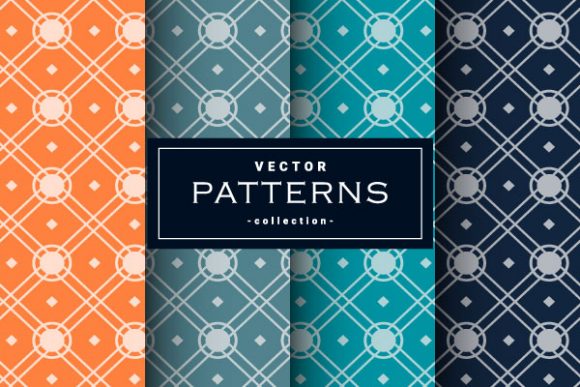
Square Seamless Geometric Patterns Set: A Modern Design Essential
Cohesive visual language sits at the heart of every memorable brand, website, and product. The Square Seamless Geometric Patterns Set represents far more than a collection of repeating tiles—it embodies a shift toward efficiency, consistency, and emotional resonance in contemporary design work. For creators who need surfaces that feel deliberate without overwhelming the core message, this kind of resource solves a quiet but persistent tension: how to add depth and rhythm while keeping content front and center.
Understanding the Core of Square Seamless Geometric Patterns
At its simplest, a seamless geometric pattern repeats infinitely without visible seams or abrupt edges. When that pattern is built on a square tile grid, it unlocks predictable alignment, easy scaling, and versatile layering. The geometry can range from crisp right-angle grids and interlocking polygons to concentric lozenges and optically rearranging cubes. What makes a thoughtfully designed set valuable is not the complexity of any single tile, but how the collection works as a system—offering variations of weight, density, and character that communicate different moods while sharing visual DNA.
Unlike organic textures, geometric patterns carry an inherent suggestion of order and intentionality. That quality makes them particularly suitable for applications where trust, precision, or modernity need to be signaled—think fintech dashboards, editorial layouts, packaging for wellness brands, or stationery lines targeting design-conscious consumers. The square format further echoes digital interfaces and printed grids, allowing integration that feels native rather than imposed.
Why Designers and Businesses Are Paying Closer Attention
Over the last few years, the conversation around visual assets has matured considerably. It is no longer enough to apply a generic background or rely on stock imagery that feels disconnected from brand identity. Audiences, subtly but consistently, have developed a keener eye for authenticity and craft. A Square Seamless Geometric Patterns Set responds to this by providing customizable, repeatable building blocks that can be recolored, overlaid, or masked to feel bespoke—even when the underlying structure is ready-made.
The renewed interest also reflects a broader emphasis on modular design systems. From product interfaces to marketing collateral, teams aim to create libraries of elements that combine predictably. A geometric pattern tile becomes a reusable component that maintains visual consistency across brochures, social media templates, email headers, and packaging. This modular mindset reduces decision fatigue for solopreneurs while giving larger teams a shared graphical language that speeds up production without sacrificing polish.
Seamless Patterns in Changing Habits and Workflows
Creative habits have shifted dramatically toward concurrent project management and rapid iteration. Freelance designers no longer present a single concept; they produce multiple variations within tight deadlines. Small business owners, sometimes handling their own marketing, need assets that work immediately without extensive manipulation. Educators curate visually clean materials for online courses where background distractions can undermine learning. In all these scenarios, a reliable square-based geometric tile set becomes a quiet infrastructure—something that can be applied quickly, knowing it will not unravel when duplicated or resized.
The rise of no-code and low-code website builders has also influenced how patterns are deployed. Users who might never open traditional graphic design software still want to apply a textured hero section or a subtle geometric overlay to blog post cards. A well-exported seamless tile, offered in multiple file formats, lets these creators achieve a professional look without needing to understand pattern construction from scratch. The pattern set thus bridges the gap between democratized tools and high-quality output.
Practical Applications Across Industries and Media
The true versatility of a Square Seamless Geometric Patterns Set emerges when we move beyond the screen. Consider the following examples observed in real-world usage:
- Brand identity systems — A tea company uses a delicate diamond lattice as a secondary brand element, printed on tissue paper, loyalty cards, and storefront window frosting. Because the pattern is square-based, it aligns perfectly with die-cuts and packaging modules.
- Digital product design — An app onboarding flow integrates a low-opacity geometric grid behind illustrations, creating a sense of technical sophistication without distracting from the illustrations themselves. The pattern's repeatability ensures it looks crisp on every device resolution.
- Print and editorial design — A magazine art director masks a square geometric pattern within pull-quote areas and section dividers, lending the publication an architectural feel that echoes the issue's theme of urban innovation.
- E-commerce and product presentation — A ceramics studio uses a subtle hexagonal tile pattern as a background for product photos and packing slips. The square tile basis means it renders cleanly whether used as a full-bleed website element or a small sticker.
- Educational and presentation materials — A corporate trainer slides a refined chevron pattern into presentation templates, replacing flat color blocks with a textured alternative that feels modern but not busy.
These examples share a common thread: the pattern acts as a supporting actor, not the lead. That is precisely what makes a Square Seamless Geometric Patterns Set so practical—it enhances without hijacking.
The Evolution of Digital Pattern Libraries
Ten years ago, acquiring quality seamless patterns often meant licensing individual designs from scattered marketplaces or constructing them manually from disparate vector elements. The process was cumbersome and frequently resulted in mismatched styles. Today, curated sets are designed with relationships in mind. A single download might contain 20 to 40 tiles that share proportions, line weights, and positive-negative space ratios. This internal consistency allows users to rotate between pattern tiles within a single project without visual jarring.
Another significant advancement is the inclusion of editable source files. Many modern sets arrive with fully layered vectors, bitmap textures, and even smart object templates for Photoshop or Figma. This shift acknowledges that end users want control—changing stroke thickness, replacing a sharp corner with a rounded one, or adjusting the overall scale to match a specific layout grid. The Square Seamless Geometric Patterns Set, when built with this philosophy, becomes a starting point for customization rather than a rigid final product.
Aligning with User Expectations and Experience Standards
Today's users, even if they cannot articulate design terminology, perceive when something feels "off." A pattern that breaks at the edges of a container, warps awkwardly on a curved surface, or creates unintended optical illusions quickly undermines credibility. Seamless geometric patterns sidestep many of these pitfalls when they are properly constructed. The square tiling method inherently supports clean repetition, and the predictability of geometric shapes reduces the risk of moire effects and other artifacts.
Accessibility also enters the conversation more frequently. Designers evaluating a pattern set now ask whether it maintains sufficient contrast when overlaid with text or UI elements. A good collection will include lighter and darker variants, or at least be easily adjustable in luminance without breaking the seamless property. This pragmatic consideration aligns with a maturing design culture that values inclusive user experience over surface-level decoration.
Psychology and the Subtle Influence of Geometry
There is a reason geometric forms have endured across centuries of art and architecture. Patterns composed of squares, triangles, hexagons, and intersecting lines convey stability, logic, and continuity. When viewers encounter a well-executed geometric background, they often register calm engagement or heightened focus—responses that benefit everything from meditation apps to financial reports. A Square Seamless Geometric Patterns Set can be deployed deliberately to evoke these states without resorting to literal imagery or cliché gradients.
Even subtle variations in tiling density can shift perception. Tighter patterns may feel dynamic and energetic, suited for youth-oriented brands or event promotions, while more open, airy grids suggest minimalism and clarity. Savvy creators use multiple tiles from the same set to differentiate sections of a landing page, guiding the user's emotional cadence as they scroll.
Integrating Pattern Assets into a Sustainable Creative Routine
Adopting a pattern set effectively means embedding it into repeatable processes. A freelancer might set up a base Figma file with the top five favorite tiles pre-configured as global fill styles, enabling drag-and-drop application across frames. A small marketing team could store a recolorable SVG tile in a shared asset library, ensuring that every team member—from social media manager to event coordinator—uses the exact same source file. For bloggers and content creators, having a rotating selection of geometric backgrounds on hand reduces the time spent hunting for new supporting visuals with each post.
This routinization might sound mundane, but it frees cognitive bandwidth for higher-level decisions. When you never need to wonder whether a background will tile properly or clash with adjacent elements, you can concentrate on messaging, composition, and narrative.
Evaluating Quality in a Square Seamless Geometric Patterns Set
Not every set is created equal, and the market offers a wide spectrum from hastily auto-generated tiles to meticulously handcrafted collections. When assessing a set, several practical markers signal quality:
- True seamlessness — The pattern must tile without gaps or misalignments on every edge. Testing at various zoom levels and on different screens reveals flaws that a thumbnail might hide.
- Vector precision — Clean anchor points and organized layer structure in AI or SVG files make editing and recoloring far less tedious.
- Variety without fragmentation — A cohesive set offers variation in density, motif, and complexity while retaining a unified stroke weight and geometric logic. Each tile should feel like part of the same family.
- File format diversity — At minimum, high-resolution raster tiles (PNG with transparency) and scalable vectors (SVG, EPS, AI) cover most use cases. Additional Photoshop patterns or Figma styles save time.
- License clarity — Whether for personal projects, client work, or merchandise, the license should match intended usage without gray areas.
Taking a few minutes to inspect these details prevents friction later, especially when a pattern is already embedded across dozens of pages or printed materials.
The Overlap with Current Technology and Creative Practices
As browsers improve support for CSS background-repeat properties and vector formats like SVG gain near-universal adoption, the technical barriers to using seamless patterns have largely disappeared. Modern websites can reference a single pattern file, define its repeat behavior, and achieve lightweight, resolution-independent decoration that loads faster than large hero images. This technical streamlining further normalizes the presence of geometric patterns in everyday digital environments, from personal blogs to enterprise dashboards.
In parallel, 3D and augmented reality design have begun to incorporate 2D patterns as mapped textures. A square geometric tile can wrap around virtual product mockups or exhibition stand visuals, maintaining crispness across surfaces that would distort irregular patterns. Forward-looking brand strategists are already considering how their 2D pattern libraries can extend into immersive formats without aging prematurely.
Avoiding Common Missteps and Over-Reliance
While the utility is clear, patterns should always serve the project, not the other way around. A frequent misstep involves applying a busy geometric tile behind dense text, creating visual competition that reduces readability. Others rely so heavily on a single tile that the asset becomes over-associated with the brand and starts to feel like a dated wallpaper. The Square Seamless Geometric Patterns Set works best when rotated, layered with varying opacities, or used in selective zones rather than full-bleed everywhere.
Another important reminder: geometric patterns are not a substitute for a weak composition. They shine when they support a strong layout, enhance negative space, and bring a cohesive thread to disparate elements. Seeing them as a foundational layer rather than a salvage tool keeps projects honest and visually crisp.
Realistic Outlook and Enduring Value
Will geometric patterns remain relevant? All evidence suggests they will, not as a fleeting trend but as a category that adapts incrementally. The clean lines and mathematical order resonate with ongoing preferences for minimalism, clarity, and structure. As color palettes shift and user interfaces evolve, the underlying geometry of a square tile set outlasts surface trends. A pattern that feels striking in 2025 can, with subtle hue adjustments, feel equally at home in 2035.
The Square Seamless Geometric Patterns Set, when chosen wisely and applied thoughtfully, joins a creative toolkit not as a disposable gimmick but as a practical, reusable resource. For professionals, entrepreneurs, educators, and hobbyists alike, that kind of adaptable, consistent quality is worth far more than the initial price of admission. In a landscape saturated with short-lived visual gimmicks, the quiet reliability of well-crafted geometric repetition offers a small but meaningful anchoring force—one tile at a time.